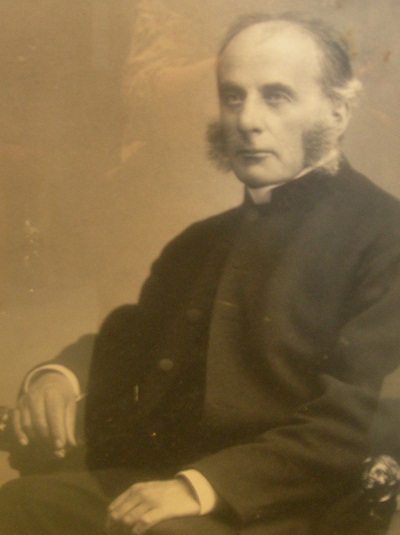
Reverend Edward King Elliott
Edward King Elliott exerted major influence over worship in Worthing and was a leading evangelical minister, promoting temperance and education, leading by example in his tireless work among his parishioners. He was very evangelical and anti-High-Church publishing a number of pamphlets on the theme as well as other works including ‘From Death a Resurrection’. For more than fifty years he immersed himself in the work of his parish before retiring in 1905 when his son Edward James Elliott returned from Trinity Vicarage in Wakefield, Yorkshire to succeed him.
His father, Edward Bishop Elliott was Rector at Tuxford in Nottinghamshire and Edward was born there in 1828. Having attended school in Blackheath, Kent, he entered Trinity College Cambridge in 1845 where achieved his BA in 1852 when he was ordained a deacon and in 1856, achieved an MA. He had become a priest in 1853 and in that same year his great uncle, the Reverend Peter Wood, Rector of Broadwater for 56 years, died. Edward, after a brief career as a naval officer, succeeded Peter and was to almost match his incumbency by serving for a further 52 years before being succeeded by his own son, Edward James Elliott.
Strong faith, evangelical views and considerable affluence and influence were prevalent among his extended family and ancestors. Emily Elliott, a great-granddaughter of Edward King Elliott’s grandfather Charles by his first wife, wrote a diary in which she recorded details of her ancestors and her own. She understood that Charles had gone to London from Essex, had trained as a cabinet maker and within four years of his arrival he had become a partner. He had arrived in London with only a shilling to his name but left with more than a quarter of a million pounds and in 1793 his entry in ‘The Cabinet Maker and Upholsterer’s Drawing Book’ by Thomas Sheraton read:
‘Elliott Charles, Upholsterer to his Majesty and Cabinet-maker to the Duke of York, New Bond Street’
He had established himself as one of the most noted cabinet makers of his day and was asked to arrange the funeral carriage for the body of Lord Nelson. His wealth enabled him, among others, to lend money to Pitt’s government at a high rate of interest and Emily believed that it was this, combined with his hard work that enabled him to retire in 1818 to Westfield Lodge in Brighton.
Charles also had a property at Clapham, London and among his close circle by this time were the Venns and the Wilberforces. Henry Venn was an evangelical minister and one of the founders of a group known by many as ‘The Clapham Sect’. They were, in fact, not a sect but a group of active, influential social reformers within the Church of England with William Wilberforce leading the parliamentary campaign for their aim to abolish slavery. Henry’s friend John Thornton, a banker, bought the advowson of Clapham and established Henry’s son, John Venn (grandfather of John Venn the mathematician) as Rector.
After the death of Charles’s first wife, Sarah, in 1784 he subsequently married Henry Venn’s daughter, Eling. Three of the five children from his first marriage had survived and he went on to have a further nine children with Eling, among them, Edward Bishop Elliott (Edward King Elliott’s father), Charlotte Elliott, authoress of many hymns including ‘Just as I am’ and Henry Venn Elliott founder, Rector and first incumbent of St. Mary’s Church Brighton and founder of St. Mary’s Hall. Henry was succeeded as Rector by his own son, Julius, who sadly met an early death. Three beautiful stained glass windows are set within the church as family memorials.
Edward Bishop Elliott was a premillerian and was concerned with all aspects of prophecy. His book ‘Horae Apocalypticae or A Commentary on the Apocalypse’ is still widely admired and was referred to by Charles Haddon Spurgeon (the Baptist ‘Prince of Preachers’) as ‘the standard work on the subject’. He had accepted the Vicarage of Tuxford (in the gift of Trinity College Cambridge) in 1824 and two years later married Mary King, daughter of John King esq. of Loxwood. Mr. King was himself an influential gentleman and had been appointed High Sheriff of Sussex for the year 1818.
John King had married Mary, the sister of Peter Wood, who had been Rector of Broadwater since 1797, the advowson having been purchased some years earlier by his father, Henry Wood of Henfield, Lord of the Manor of Wantley. There is some evidence in personal letters to Ellen Wood, Peter’s wife, that Mrs. John King (Mary Wood) had died while her daughter Mary was still an infant and that Peter and Ellen had raised the child ‘as a daughter’. The relationship between Mary King and her uncle and aunt was a very close one and in all probability influenced the continued close relationship between Mary’s own son, Edward King Elliott and his great uncle and aunt. However, Mary also died young following severe haemorrhaging after the birth of a daughter, Eling, in 1833.
Edward Bishop Elliott, left a widower with four small children, was devastated and wrote to Ellen: “Precious, precious creature! Oh, who can tell what she was to me!” The name Eling was his own mother’s, but the child’s full name was to be Eling Mary Wood Elliott. He told Ellen that ‘Wood is the name of those who were to her as parents and you will not like any name as well before Wood as Mary’.
His grief at the loss of his wife is very evident in the letter, but so also is his strong faith and that of his friends and family. Edward King Elliott was then just five years old and together with one of his sisters he was taken in temporarily by a family friend. Later, after the funeral, it appears that he and his father and two of his sisters went away on a brief tour of Derbyshire with two Elliott aunts.
Edward King Elliott’s own faith as a child is indicated in a letter from Mr. Easterfield, the school master at Tuxford, who overheard a conversation between his youngest child and Edward. His son had commented on how pretty Edward’s mama’s flowers looked and how they had ‘come on so’ since she was there. Edward replied, “My Mama walks in heaven and she can see all the pretty flowers”.
Peter and Ellen Wood had no children of their own and the relationship with Edward King Elliott was such that Peter left him not only the advowson in his will, but also land and properties. Thus, Edward succeeded to the appointment of Rector of Broadwater on the 24th May 1853 and in July of the same year he married Mary Anne Elizabeth Richey, daughter of the Reverend J. Richey at Stoodleigh in Devon, in a service officiated over by her uncle, the Reverend G. Bellet.
Over the next eight years the union was blessed with three daughters and two sons. The oldest daughter, Mary Alma was eventually to marry the Reverend Pilcher, but Julia and Alice remained single and are buried beside their parents in the cemetery. Henry Wood Venn Elliott pursued a naval career, reaching the rank of Rear Admiral by the time of his father’s death, while Edward James chose a life of service to the church.
Edward King Elliott continued the work of his forebears by evangelising, writing and working tirelessly for the good of parishioners and was also active in church affairs. For example, in 1887, together with others including the Earl of Lichfield, he appears to have petitioned against the proposal for a new parish (St. Andrew’s Worthing). The parish was to be formed by taking parts of the parishes of Holy Trinity Worthing, Christ Church Worthing and Broadwater; her Majesty, however, was pleased ‘by and with the advice of her Privy Council to approve’ the formation of the new parish. A further example was his request in 1898 Edward to the Ecclesiastical Commissioners that the advowson of St. Paul’s Worthing, vested in him, be transferred to Francis John Mount, Archdeacon of Chichester.
When he reached his jubilee year Edward was told by Mr. Snewin that a jubilee fund had been raised. Mr. Snewin reported that Edward, ‘having seen [an account] of the contemplated testimonial in the local press intimated his gratitude for the kindness of his friends and expressed a desire that the testimonial should take a form which was to be a public benefit and that his wish was for a clock to be placed in the tower of Broadwater Church’.
In accordance with this wish, the clock was duly ordered and on May 18th the following was recorded in the committee notes:
Clock with one dial: £145. 0s. 0d.
For an extra dial: £15. 0s. 0d.
Approx. cost of carpentry: £10. 0s. 0d.
It was recorded that the estimate, with extra dials, was to be accepted although it was found necessary to discontinue the chiming of one of the bells in order to obtain the space necessary for the clock weights. In addition, a brass tablet that is still in situ was to be fixed in the church at a total cost of £12 for manufacture and fitting. The committee also arranged for a jubilee memorial album to be compiled.
During his time as Rector, Edward twice sold land to extend the cemetery. In 1861 he sold 4 acres for £600 plus tenants’ compensation of £66 and having been asked again in 1884, he sold a further 4 acres at £200 an acre having originally sought £420 per acre. (Mr. Tribe, simultaneously, was offered £300 an acre!) In 1888 Edward objected that an entrance to the cemetery had been made from the footway through his glebe land, despite his request upon sale of the land that this should not be done. The Cemetery Board were not aware of any legal restraint and appear to have ignored his objection. In a similar fashion, his objection to a hole being made in the cemetery wall, looking into his land was dismissed. He requested an acknowledgement of his right to build up the wall should he wish, but the board felt that ‘as the hole consists of only a few air bricks such an acknowledgement is not necessary’.
By many accounts Edward was a modest and hard-working man and was acknowledged in his obituary in the Times (2/11/1920) as ‘one of the best known evangelical clergy in the south of England’. His modesty is further borne out by his request in his will that his funeral should ‘be as plain and inexpensive as possible’. Among personal items left to his family was the memorial album, with a with a wish that it ‘be retained in my own family after my son’s time and so much longer as may be possible’.
In 1904 Edward ‘placed himself at the disposal’ of the Worthing Gazette and shared his extensive knowledge of St. Mary’s church. He talked mainly about the building and efforts over the years towards repairs and restoration, but he also spoke of his friendship with Edward Hide and how their collective memory spanned 140 years to a time when Worthing was simply ‘a collection of huts’.
In 1905 he resigned and presented his son Edward James Elliott as Rector but sadly in the same year his daughter Julia passed away. The advowson, had already been sold to a Mrs. F. M. Walter, ‘she reserving one turn’ and then was eventually given to the Martyrs Memorial Church of England Trust. It is possible that the ‘reserved turn’ ensured Edward James’ incumbency but that Edward King Elliott already desired the eventual return of the advowson to the church authorities.
Edward retired to Rectory Cottage with his wife, who died in 1909 and his daughter Alice who died in 1950. He remained there until his death on October 31st 1920 (news of which even reached the Adelaide Advertiser) and the cottage together with its adjoining land was left to Alice. The congregation for the funeral service was ‘composed almost in its entirety of parishioners who had come to render their last respect to one who had laboured so long and so faithfully’, as had the clergy of the six churches of the borough. On November 4th Edward was interred at the cemetery in an oak coffin which had, for the service been adorned with a floral cross and was lowered into a grave lined with laurel and bay, all of the arrangements having been made by Mr. Snewin.
Edward’s son, Edward James Elliott, who had succeeded his father as Rector in 1905 continued in his work for a further twenty-two years and is also interred in the cemetery. His death on February 15th 1927 brought to an end the family’s one hundred and thirty one years of devoted service to the parish.